Aon Fit Out Case Study: A new standard for workplace sustainability in Ireland

The Aon office at 15 George’s Quay, Dublin, achieved LEED v4 Commercial Interiors Platinum with 88 points, the highest-scoring fit-out in Ireland, as well as WELL Platinum certification. A landmark achievement in workplace sustainability and design.
Background
Reddy A+U were appointed by Aon as workplace strategists and interior architects to consolidate multiple satellite offices into a single headquarters. Through a two-month programme of workshops and staff surveys, a bespoke workplace strategy was developed to support collaboration, focused work, and hybrid working, while encouraging office return through improved amenities.
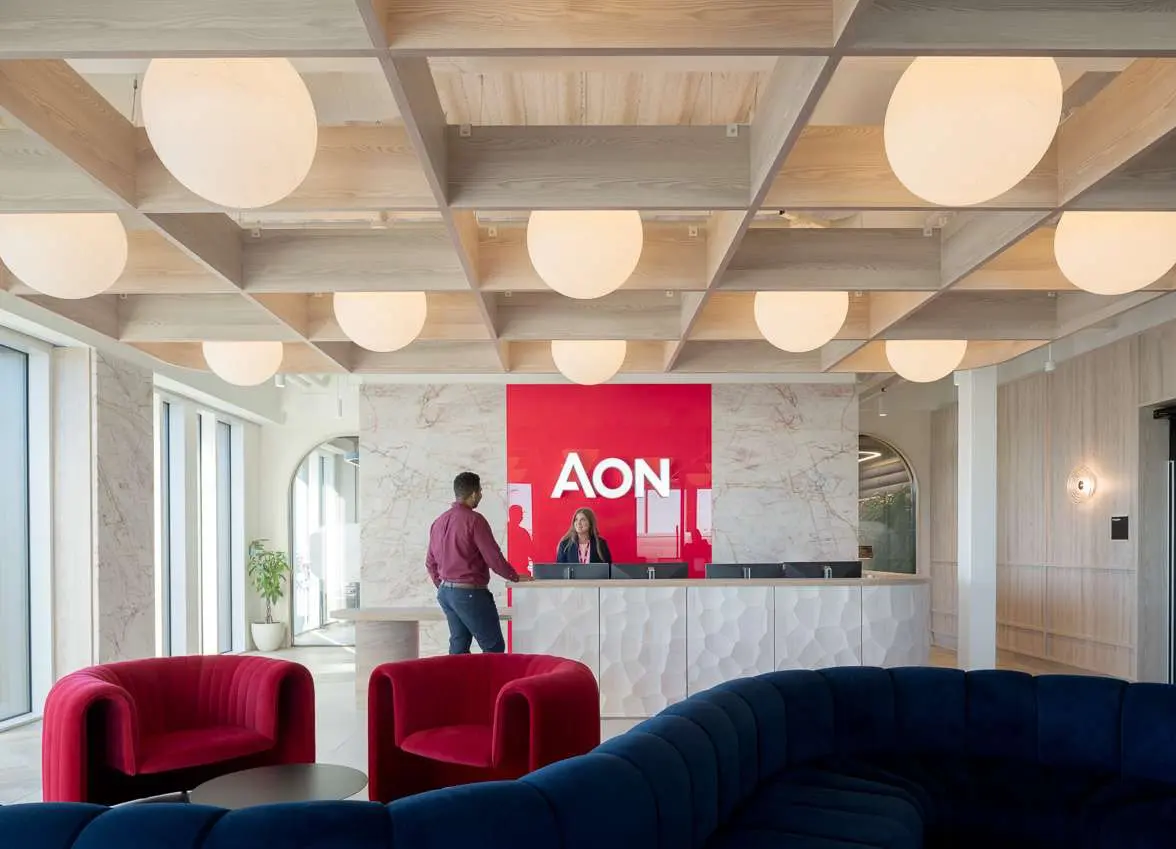
The design places emphasis on both functionality and experience. A central spine of meeting and focus rooms with acoustic treatment supports concentration, while curved forms and bespoke details create a distinctive identity. Experiential design connects staff and visitors to AON’s brand and location, with site-specific graphics, curated photography, and crafted features such as a rippled ash-wood reception desk inspired by views of the River Liffey. The 5th floor houses reception, café, and flexible meeting spaces, designed to welcome both daily users and international visitors with thoughtful amenities including integrated luggage storage.

The Brief
The location, overlooking the River Liffey, provided the opportunity to create a flagship workplace that would align with Aon’s corporate values, ESG objectives, and the expectations of a modern workforce.
The client brief emphasised three key goals:
- Sustainability — achieving the highest environmental performance possible.
- Employee well-being — supporting comfort, collaboration, and inclusivity.
- Future adaptability — designing for resilience and flexibility in a rapidly evolving work culture.
Design Approach
Reddy A+U responded with a design strategy that embedded sustainability from the outset. Rather than treating LEED and WELL as an end-goal, the certification was used as a framework for decision-making throughout the project. Key elements of the design approach included:
 Democratic use of space
The building’s best views toward the Liffey were designated as collaborative and breakout areas for all staff, rather than reserved for senior management. These spaces are defined by planting, mesh screens, and acoustic curtains, creating inviting areas that balance openness with acoustic comfort.
The project also prioritises inclusivity and sustainability, with step-free access, visual contrast for wayfinding, and compliant glazing manifestations.

 Furniture Reuse
To minimise landfill waste, 30% of furniture from AON’s previous premises was reused, including task chairs, desking, monitor arms, red meeting booths, and Zoom room chairs. Careful integration into the new design ensured these pieces complemented the interior’s strong curved geometry and layered textures.
 Sustainable Materials
Sustainably sourced timber and locally produced materials reduced both environmental impact and transport emissions. Products with transparent life-cycle data and proven social, economic, and environmental benefits were prioritised, such as recycled vinyl wallpapers and reconstituted stone tiles. Ceiling finishes were minimised: instead, Rockfon acoustic rafts were installed over desks and Sonaspray over breakout areas, following acoustic consultant recommendations.

 Daylight and Healthy Workspaces
Cellular spaces were positioned along the building’s central spine, ensuring open desk areas benefit from maximum daylight and external views. Mid-floor tea points and wellness rooms give all staff access to filtered water and healthy snacks.

 Lighting and Finishes
Energy-efficient 3000K LED multiway lighting reduces consumption while creating a warm, inviting atmosphere. Recycled Interface carpet tiles and LVT flooring were selected for their environmental credentials, acoustics, and durability. Tactile finishes, such as linen-effect wallpapers and stain-resistant fabrics, contribute to a hospitable environment. Staff have remarked on the comfort these design details provide. Artificial lighting is controlled by dimmable LED luminaires with occupancy sensors to encourage daylight use and minimise waste.
 Innovative Detailing
Custom curved glazing details were developed to achieve biophilic forms using standard systems, balancing uniqueness with practicality for cleaning and replacement. Curved metal mesh screens separate desking from collaboration areas without blocking daylight. These screens also support biophilic planting, enhancing visual connection to nature.

 Smart and Efficient Systems
The building integrates smart-enabled technologies that adjust dynamically to optimise comfort and conserve energy. Fans feature Variable Speed Drives with Specific Fan Powers ≤1.6 W/l/s, and high-efficiency plate heat exchangers or thermal wheels recover energy with minimal cross-contamination.
Multi-purpose chiller heat pumps supply four-pipe fan coil units that operate in heating, cooling, or simultaneous heating/cooling modes with heat recovery. This flexible system allows south- and north-facing zones to be conditioned differently while maintaining high operating efficiency at low compressor speeds. Low-temperature heating (45ºC) further enhances efficiency compared to traditional systems. The building also achieves WiredScore Platinum, demonstrating digital connectivity excellence.
Water conservation measures are supported by a rainwater harvesting system for irrigation as well as dual-flush systems for toilets and aerators on taps.
 Inclusive and Accessible Design
Reddy A+U worked closely with occupational therapist Linda Horgan from the outset to embed inclusive design principles throughout the scheme. The approach considered neurodiversity, physical ability, gender, and religious needs to create a workplace where all employees feel supported. Accessibility extends to all spaces and amenities, with strategies in place to reduce the risk of injury, confusion, or discomfort. Features such as clear sightlines, well-designed lighting, and clearly marked emergency egress plans enhance security and ease of navigation. Provisions have also been made for service animal access, ensuring inclusivity across diverse user groups.

In compliance with TGD-M regulations, glazing units are fitted with permanent manifestations, enabling people with visual impairments to clearly identify doors and glazing locations. Visual contrast has also been carefully considered across elements such as door handles, wall finishes, fittings, and signage. These contrasts provide critical spatial information, supporting intuitive wayfinding and orientation.
Two large wellness rooms were included, designed to function flexibly as respite, prayer, or parent rooms. Quiet desking zones with higher acoustic screens were located at the periphery for noise-sensitive employees, complemented by winged-back acoustic chairs, rockers, gravity chairs, and focus rooms with colour-change lighting to aid concentration and provide recovery from sensory overload. These focus rooms were intentionally positioned near collaboration and activity areas, ensuring easy access while avoiding any sense of exclusion. Users can step away when needed and re-join colleagues seamlessly.

A diverse mix of furniture was selected to meet a wide range of ergonomic needs, including variations in seat height, support, and posture. Many items feature soft-touch, natural materials and tactile surfaces that provide a calming, sensory-rich experience. Several seating options are enclosed in form, offering a cocoon-like environment that enhances comfort and relaxation.
This layered design approach recognises the wide spectrum of human needs and experiences, fostering equity, dignity, and wellbeing across the workplace

 LEED Certification Outcome
The project achieved 88 points under LEED v4 for Commercial Interiors, the highest score in Ireland in its category. This distinction underscores not only technical achievement but also a holistic design philosophy that integrated sustainability, wellness, and functionality.